Showing posts with label sync-speed. Show all posts

Tuesday, September 29, 2009

lausanne_portraits

lausanne_portraits-2

Settings: Ambient (on the subject) is one stop below neutral grey. Flash is one stop above neutral grey.

This past week I traveled to Lausanne to vacation and attend a strobist meetup. I had a great time and got a chance to photograph two very good models, Sandra and Scott. I was a group leader, and when we were asked if any group wanted to use the library, I volunteered, as it was very bright and sunny outside, and I didn't know the campus we were on. I didn't want to lose too much time walking around looking for a spot. Once in the library, the tables and chairs near the brightly lit windows immediately drew my attention. I explained how that when walking around looking for locations, I use my hand to envision how the ambient light will fall, and how bright the exposure on it compared to things in the background will be. It's much faster than having the camera up and trying to arrange the model. It's like a divining rod for pleasing light.

Once we were all set up, I asked the group if they wanted me to walk through a normal shoot, and they said yes. I'll try to repeat all the steps and explanations here.
lausanne_portraits-1

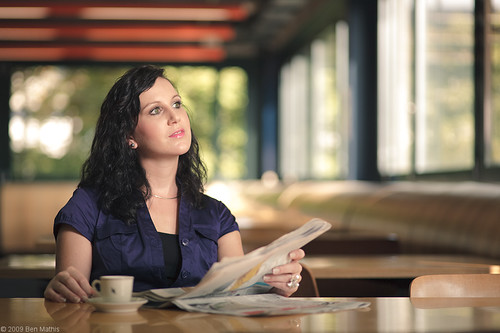
This first image is the natural light only. I explained my first choice is always lens fov. Because of the location, a wide angle lens would have revealed that this was just a row of tables at the edge of a library, and for the narrative of this photo, I wanted it to feel more like a warmly lit cafe. A telephoto lens would compress the scene to only show the row of tables and give a more blurry background, creating more subject isolation, and a pleasing pattern of all the background patterns.

Step two for me is to figure out ambient exposure. If I'm planning to use flash, I use 1/180 as my ceiling for shutter speed (1/200 is the 5d sync speed, but I can't seem to get my skyport/quadra setup to reliably sync, but it always hits 1/180, and I have my camera set to half, rather than third stop exposure changes, so 1/200 doesn't show up anymore, but 1/180 does). It was really bright in this room so I was able to use ISO 100, 1/125 and f/2.

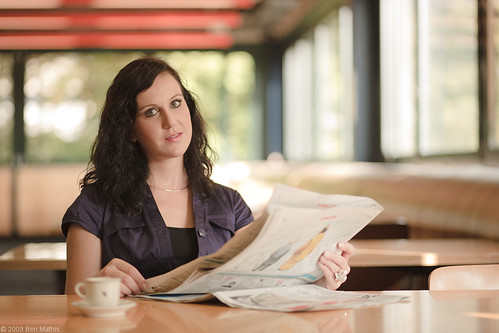
We noticed that the background really blew out in brightness, so our next step was to try to control the background, and use the flash to augment the existing light. The goal was to get the same overall feel as the ambient only image, but with complete control of background and subject illumination. I doubled the shutter speed to 1/250 to darken the background. This left the face quite dark, but I positioned my softbox in the same location as the window, and powered it up to match. Because I did not want spill on the table, the shutter at 1/250 managed to block the flash from hitting the table, which was a convenient feature.

lausanne_portraits-2

The light is a bit more contrasty and specular than the window light only, but to be honest I prefer it that way. It's not quite as appropriate for women as for men, but she had sufficient makeup on that it worked well anyway. Specular highlights tend to work nicer in bringing out skull structure on men, whereas women look better looking smooth and matte.

Notice how in the ambient only image, the bright areas in the background fight for visual attention with her face. In the flash lit image, we were able to darken the background, add a bit of volume to her face, and bring it out brighter. Now there is no question where the eye should go, directly to the subject's face. With this control we could darken the background even more, or let it bleach out. The flash frees us from the ratio of the ambient only.

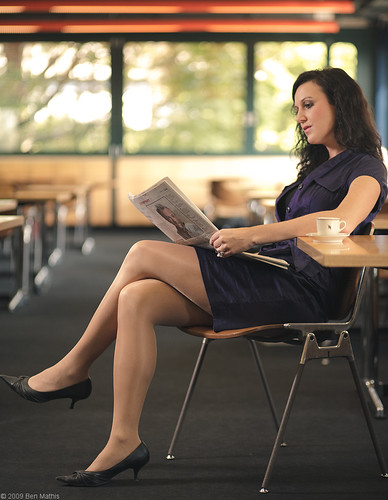
Next I wanted to try a different feel. With the crop occurring mid-torso, it has a more relaxed location feel. But since she had very nice legs and a short dress, I felt that a more full body shot would be more beauty/glamor. I asked her to move the chair to the edge of the table so that I could see all of her.
lausanne_portraits-3

Settings: Ambient (on the subject) is even with neutral grey. Flash is one stop above neutral grey.

For this the flash is coming from almost directly in front of her face, perpendicular to the camera. One of the group members asked about how the light would work in terms of reading well, since the ambient light is clearly coming from the other side. I said that since it was an indoor location, there would most likely be interior lights, and having a light source coming from the other direction was ok and would most likely still read well. It was a good question though, as it's good to have your light motivated by existing ambient. It is possible to break the lighting on the subject so they appear not to actually exist in the background.

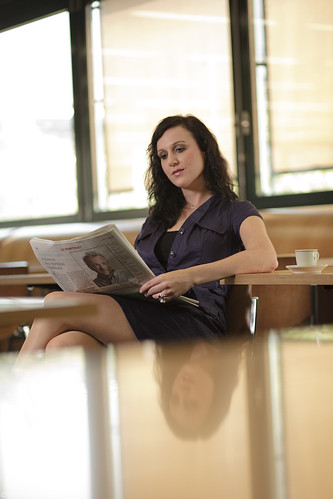
I also explained that once I have a lighting setup and pose that I like, it's fun to explore around to the different angles, and you can potentially find a really nice image that you hadn't pre visualized. This was one such example.
lausanne_portraits-4

This was the first part of the day, I will cover the second portion tomorrow or the next day.

Monday, August 25, 2008

Gróto again

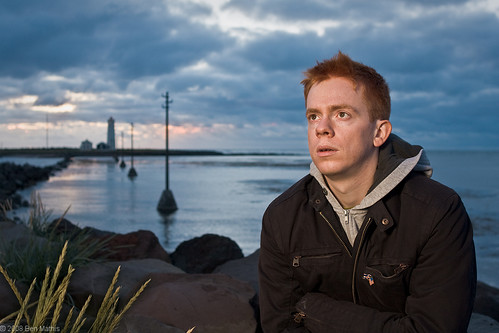
agust_wistful

Settings:
1 Vivitar 285hv
flash at 1/2 power,
through 1/4 CTOrange gel,
at normal telephoto zoom,
into silver umbrella,
light stand was at 2 meters height,
light was .5 meters to left and even with camera,
aimed directly at subject.

Whenever the sunset is looking nice, I am always tempted to run down with any available subject and do some portraits. This past Saturday I gave in to the temptation and raced down. It was quite windy, so I was limited in where I could place the umbrella. I had my left arm straight out, holding the light stand. I gelled the flash slightly, so that in post, I could adjust the WB to be a bit bluer, but still retain a warm look to the subject. I started at my max sync speed of 1/250, got my flash settings right for the subject (I started at 1/4, but had to bump up to 1/2), then I lowered the shutter till the background was the brightness I wanted.

I sat Agust in such a position to put him in line with the leading lines of the telephone poles. This would compositionally balance the image and give something else to look at in the background, at a place of power. Unfortunately it left grass in the scene. Originally it was very bright, yellow, and distracting. I just used Lightroom 2's new adjustment brush to quickly darken, green-ify, and reduce contrast, so that it could be there as another layer of foreground, but not be as distracting. I also added green to the sky, pinked up the sun poking through, and made a mask for Agust's face. I used that mask to de-saturate a little, bump exposure, contrast, clarity, and sharpness. I do that often now on faces to make sure they are the most clear and attention drawing element of the scene.

Saturday, June 7, 2008

Sync-speed explained

Max sync speed. It's an important term, but it can seem hard to understand. It's the maximum speed at which your camera can take a photo and still get the flash to hit the entire sensor.

Here is an example image to help explain:


Most modern DSLRs have two shutter doors, a top and a bottom one. When you press the shutter button, the top one starts to raise, and then the bottom one starts to follow, till they both meet, closed, at the top. The speed you set your shutter will determine the time between when the top door starts moving and the bottom door follows (your camera make/model also can affect this).

Your max sync speed is essentially the setting at which the top door has reached the top of the sensor before the bottom door has started moving. It provides an entirely unobstructed view of the sensor for the flash to come in. A flash's duration is around 1/4000 or faster, so it will always be fast enough to hit the sensor for only a fraction of your shutter duration.

If you set your camera to faster than max sync speed, say 1/320 of a second, when your flash fires, the bottom door will already have started upward, and will be blocking a portion of the sensor from getting flash. This will cause a black bar at the bottom of the image. If you go too fast, say 1/1000, you will get a black bar from both the top door and bottom door. At this speed, the opening of the shutter is essentially a small slit moving across the sensor. The bottom door starts moving almost immediately after the top door starts. This will give you a black bar on top and bottom of the image.

Some point/shoot cameras, like the Canon g9, have electronic shutters, meaning that rather than using a physical door, the camera merely shuts off the sensor. This results in being able to sync around 1/4000. There is no door in the way of the flash.

Ambient is unaffected by this property. That's why most flash photographers start their camera at their max sync speed (1/200 or so), get the flash value correct, then start lowering the shutter speed to allow in more background light. I mentioned that the flash duration is only 1/4000 of a second or faster, so it will hit the sensor the same at 1/200 as it does at 1/5 of a second. Only ambient will be affected by this change in time.

When shooting with both flash and ambient, you get an opportunity to balance the flash intensity with background intensity.

For example:

agust_sunset-4

This shutter speed is 1/125. If I changed it to 1/200, the sky would be darker, and the sunlight on his right cheek would be a bit dimmer. If I changed the shutter speed to 1/60, the sky would be much brighter, and the sunlight on his cheek even brighter. The flash fill on the left of his face would be unaffected by the shutter speed change.

You can see how this gives you power to alter your light ratios, background to foreground values, and overall scene control.